
Hockey Glossary for New Blackhawks Fans
Hockey has a vocabulary problem, and most newcomers hit it within the first period of their first game. The commentary moves quickly, the crowd reacts to things you cannot yet see and the rulebook seems to be written in code. None of it is actually complicated once the key terms are separated from the noise. This glossary covers the words you will hear most often and what they mean in practice.
You do not need to memorise everything at once. Learning a handful of terms per game is enough, and the rest will settle in as you watch. The aim is to enjoy the sport, not to pass an exam.
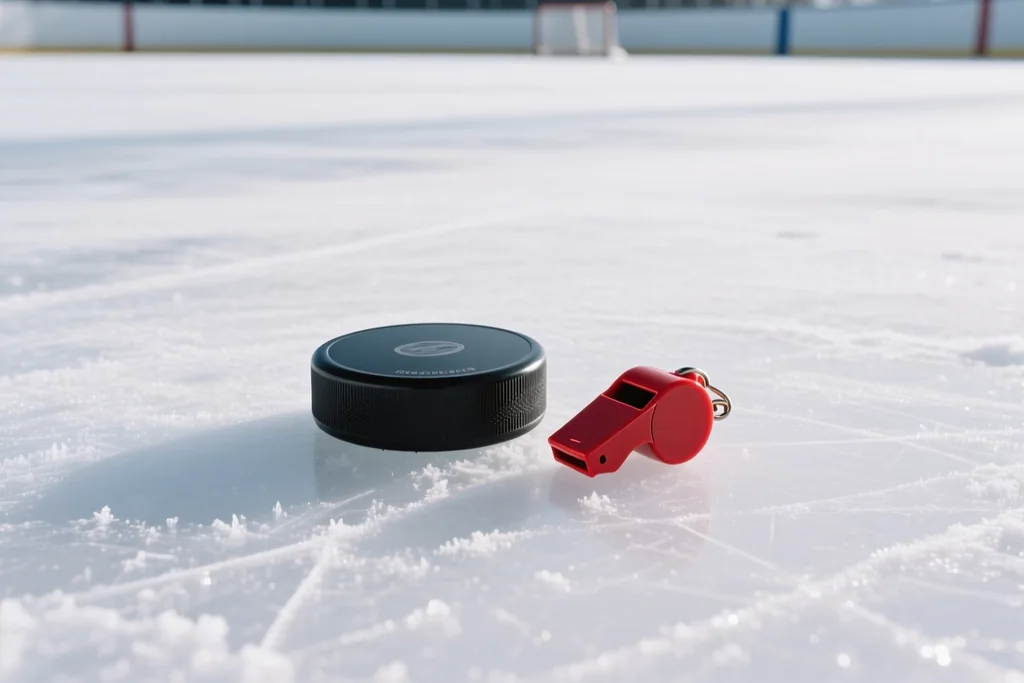
The Rink and the Basics
The game is played on an ice rink divided into zones, with a goal at each end and a centre line in the middle. Each team tries to put the puck into the opponent's goal while preventing the same at its own end. Players move on skates and use sticks to pass and shoot. Understanding the layout makes every other rule easier to follow.
Offside and Icing
Offside and icing are the two rules that confuse new fans most, and both exist to keep the game flowing. Offside stops attackers from waiting near the opponent's goal before the puck arrives, which would make the game a series of long passes. Icing prevents a team from simply firing the puck the length of the rink to relieve pressure. Once you can spot these two calls, the rhythm of a game becomes much clearer.
Both rules are called by officials, and the whistle is your cue to look at what just happened. Replays usually show the moment clearly, so a single viewing is often enough to learn the pattern. Do not worry if it takes a few games.
Penalties and the Power Play
A penalty sends a player to the penalty box for a set period, leaving their team short handed. The team with the extra player is on a power play, and the crowd expects a goal during it. Most penalties come from tripping, holding, hooking or dangerous contact. Knowing the common ones helps you follow why the game suddenly stops.
- Tripping, taking a player's feet out with a stick or body.
- Holding, grabbing an opponent to slow them down.
- Hooking, using the stick to pull a player back.
- High sticking, contact with the stick above the shoulders.
- Interference, blocking a player who does not have the puck.
Scoring and the Shootout
A goal counts when the puck crosses the goal line, and it is confirmed before play restarts. If the game is tied after the regular period, it can be decided in overtime or, at times, by a shootout. In a shootout, players take turns skating in alone against the goaltender. It is a dramatic finish and a good place for a new fan to learn the game's tension.
The Positions on the Ice
Each team puts six players on the ice, usually a goaltender, two defencemen and three forwards. The goaltender guards the net, the defencemen protect the space in front of it and the forwards chase the puck and attack. Lines rotate constantly, which is why the same faces disappear and return throughout the game. Watching who is on the ice tells you a lot about the team's intentions.
Words You Will Hear in the Stands
Crowd language is its own dialect, and a few phrases will come up in every game. Fans talk about the puck, the shift, the line and the crease as casually as if everyone already knew them. Learning them makes the conversation around you understandable. It also makes the game more fun to watch with other people.
| Term | Plain meaning |
|---|---|
| Puck | The hard rubber disc the game is played with |
| Shift | A short spell of ice time for one player or line |
| Crease | The marked area in front of the goal |
| Face-off | The restart that begins play |
| Breakaway | A player skating alone toward the goaltender |
None of these terms is difficult on its own, and together they open up most of what a commentator says. Pick up a few each game and the sport will start to feel familiar within a month. Vocabulary is the fastest way into any sport.
Getting Comfortable With the Speed
The hardest part for a beginner is not the rules but the pace at which everything happens. The puck moves faster than the eye expects, and the play changes direction within seconds. Following the players rather than the puck is a useful habit while you learn. The puck will come back into view soon enough.
Watching with an experienced fan nearby shortens the learning curve considerably, because they can explain what just happened without a replay. Ask questions during stoppages rather than during play, when attention is elsewhere. A few games is all it takes.
Special Teams and the Restart
Special teams are the units that play when a team is at an advantage or a disadvantage, and they decide a lot of games. A strong power play turns penalties into goals, while a strong penalty kill keeps the score level when a team is short handed. Coaches spend a great deal of time on both because the margins are so small. Watching a power play is a good way to see how much shape and patience matter in hockey.
A face-off restarts play after any stoppage, and the team that wins it often controls the next few seconds. Officials drop the puck between two players, each trying to sweep it back to a teammate. It looks simple and it is not. Pay close attention to face-offs and you will notice how often a goal begins with one.
A glossary is only useful if it is applied, so watch a period with one or two new terms in mind. The rules that seem arbitrary at first are the ones that will feel obvious by the end of the season. Give it time and the sport will explain itself.